Vakhtangov and the Russian theatre – update
The Russian Avant-garde – Renaissance or revolution – Book of the film series
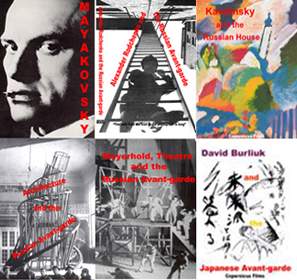
Book of the film series – More about the book I am writing in conjunction with the Russian Avant-garde film series. The series of six arts documentary films is already complete and has been for some time. They consist of:
Alexander Rodchenko and the Russian Avant-garde
Architecture and the Russian Avant-garde
Mayakovsky
Meyerhold Theatre and the Russian Avant-gardeKandinsky and the Russian House
David Burliuk and the Japanese Avant-garde
I have always wanted to write a book based on the material in the 6 films but also including additional material which I have collected over the years as well as much material which could not be included in the films themselves. I have now started the book and I am well into writing and collating material. The point of the book will be to expand the subjects outwards and in depth both visually and textually. Plus I will add material like interview transcripts and new articles. As yet there is no dedicated site for the book but that may change in the future. For the time being I will make post here or on copernicusfilms.com+Michael Craig and Copernicus Films
J-FEST Moscow 2011. Festival of Contemporary Japanese Culture
J-FEST was a festival of Contemporary Japanese culture held in Moscow at the Central House of Artists. It was designed to showcase or present Japanese culture with an emphasis on youth and young people with the accent on phenomena like manga and anime, cosplay etc. The event was held in the House of Artists in the centre of Moscow. I wanted to the film the event partly out of curiosity and partly to collect material for the Japan-Philosophical Landscapes project and maybe get an interview or two with some of the main participants and speakers at the event. We arrived an hour or two after the event had started and I was surprised by how many people had turned up. Several hundred people were milling around the foyer and in the various exhibition points where events were being held.
A fashion show was just ending in the DNK hall with fashions from the Harajuku area of Tokyo. Outside in the foyer young Russians dressed in various costumes of manga and anime style were thronging around the two floors where the event was taking place. On one side of the foyer a whole wall had been given over to Kyoto Seiko Universtity with a video instalation dedicated on the theme of the recent earthquake and a mural being painted by students from the university.
The costumes were various but mostly on the themes of maids, cosplay, anime and manga with a strong influence of gothic but generally recognisable as derived from the street fashions of Harajuku.
At the press conference the panel consisted of the architect Takayuki Suzuki and May J the singer who heads the show J-Melo on NHK . J-Melo is a cult musical TV show Japanese TV channel NHK. It is broadcast in 180 countries and regions, and finally made it to Moscow. May J. is of Japanese, Iranian, Turkish, Russian, Spanish and English extraction.
It was strange to see these symbols and emblems of Japanese culture being played out in Moscow but one way of understanding this phenomena is with reference to Takamasa Sakurai was also on the panal. A journalist and a media content producer – he is convinced that the world will certainly have a “kawaii revolution.” He is convinced that due to the popularity of their pop culture, Japan could become a diplomatic mediator between different countries. In recent years, Sakurai-san has been an active lecturer in various countries.
The next day of the festival I managed to secure an interview with Takayuki Suzuki
Suzuki-sensei is trying to reconcile modern building and new forms of the 21st century with traditional Japanese ideas of beauty. Thus, in their universitybuilding, which he designed, he tried to include as much as possible, “the sky” which “need students to dream.”
In his lecture he spoke about contemporary Japanese landscapes from the perspective of Japanese culture.
Takayuki Suzuki: “Situated in the Far East, modern Japan is one of the centers of world culture and therefore for understanding the future we need to talk about the features of Japanese culture, characteristic of the Japanese urban landscape and everyday life of Japanese youth”.
In his lecture he spoke about contemporary Japanese landscapes from the perspective of Japanese culture.
Takayuki Suzuki: “Situated in the Far East, modern Japan is one of the centers of world culture and therefore for understanding the future we need to talk about the features of Japanese culture, characteristic of the Japanese urban landscape and everyday life of Japanese youth”.
After his interview I am hoping to use some of the material for the project Japan Philosophical Landscapes. His work and ideas may form the nexus between traditional and contemporary understandings of landscape and pinch together these two major themes in the film.
Japan-Philosophical Landscapes "Gingaku ji-Landscapes and Sandscapes"
This section of the film focuses on the Silver Pavilion of Ginkaku ji. It suits my purposes over the more popular Golden Pavilion in Kyoto as it describes more directly the phenomenon of Philosophical landscapes. Most people are concerned with the Golden pavilion because of its obvious beauty, a striking golden temple set in the middle of a pond, its still golden reflection a mirrored upturned version of itself creating an uncanny sensation of a floating vision in mid air.
However in some ways the Silver Pavilion, Ginkaku ji, is no less beautiful despite its subdued presence if compared to the Golden Pavilion. The addition of moss covered grounds and what I would call “sandscapes” – abstract images made with sand and grit give it a unique quality as a Zen temple. They do not represent the landscape or depict a particular landscape but communicate an essence or idea. The cone of sand in the garden resembles Mount Fuji however this is but a surface interpretation. A mountain is seemingly a solid thing ostensibly made of hard rock. However mountains can fall or increase in size with volcanic eruptions. A miniature mountain of sand conveys this state of flux or indeterminateness of things and life which Zen Buddhism teaches. The volume of sand shaped into a cone is held in a state of static but fluid tension which can change with a gust of wind or a heavy downpour of rain and then reconstituted anew. Similarly sand as waves convey the inter penetrability of things. This constant blurring of borders between materials conveys the solid but non materiality of an idea given expression in three dimensional space. The essence of Zen Buddhism.
This section of the film focuses on the Silver Pavilion of Ginkaku ji. It suits my purposes over the more popular Golden Pavilion in Kyoto as it describes more directly the phenomenon of Philosophical landscapes. Most people are concerned with the Golden pavilion because of its obvious beauty, a striking golden temple set in the middle of a pond, its still golden reflection a mirrored upturned version of itself creating an uncanny sensation of a floating vision in mid air.
However in some ways the Silver Pavilion, Ginkaku ji, is no less beautiful despite its subdued presence if compared to the Golden Pavilion. The addition of moss covered grounds and what I would call “sandscapes” – abstract images made with sand and grit give it a unique quality as a Zen temple. They do not represent the landscape or depict a particular landscape but communicate an essence or idea. The cone of sand in the garden resembles Mount Fuji however this is but a surface interpretation. A mountain is seemingly a solid thing ostensibly made of hard rock. However mountains can fall or increase in size with volcanic eruptions. A miniature mountain of sand conveys this state of flux or indeterminateness of things and life which Zen Buddhism teaches. The volume of sand shaped into a cone is held in a state of static but fluid tension which can change with a gust of wind or a heavy downpour of rain and then reconstituted anew. Similarly sand as waves covey the inter penetrability of things. This constant blurring of borders between materials shows the solid but non materiality of an idea given expression in three dimensional space. The essence of Zen Buddhism.
Japan – Philosophical Landscapes – First part released
The last few days have been a process of clearing away old obstacles and barriers in order to proceed with a several new projects. A few years ago we spent a fair amount of time in Japan shooting material for a couple of films which I have been working on and editing. The work on this project was interrupted by the Stanislavsky film “Stanislavsky and the Russian Theatre” which is now complete. After revisiting the Japanese project it is re-emerging as web documentary called “Japan – Philosophical Landscapes”. More information about it can be found here. Also the first part has been uploaded to the internet (see below).
At the same time a new site is being constructed to accommodate the Fairground Booth Project and discussions are taking place as to how best proceed in organising the logistics of the film and its corresponding documentary projects “Carnival and the Russian Theatre” and “Vahktangov and the Russian Theatre”. Once the site is up and running details will be released.
New web documentary – “Japan- Philosophical Landscapes” almost ready for release
Some exciting work getting done at the moment. Working on the setting up of two web sites. One for a web documentary about Japanese art and culture called simply “Japan – Philosophical Landscapes”. The site is still in the process of construction so it is not fully operational as yet with some modules and elements hidden. It is a project which I have been working on and off for about two years ever since we returned from filming in Japan a second time over a three month period. At last it is taking some shape and I am ready to start releasing it in instalments on the web and have set up a new web site specifically for this purpose.
That is not to say that I have neglected the Russian Theatre project centred around Blok’s play The Fairground Booth and the two documentary films “Vakhatangov and the Russian Theatre” and “Carnival and the Russian Theatre”. I am in the process of building a website which will become the focus of this project with information, blogs and articles to chart it’s progress.
More news as things develop.
New Copernicus Films storefront for purchase of DVDs in UK
Have been updating the web site to include a store front which specifically gives the opportunity for those in the UK who are interested in buying Copernicus Films DVDs the opportunity to do so. Previously it was necessary to buy the disc on Amazon.com in the USA and pay for shipping to the UK. People have been approaching me on social websites and by e-mail wanting to purchase the discs in the UK. Now there is a facility to purchase disc in the UK with free shipping. Check here for more information. Alternatively click on the tab above PURCHASE DVDs ON LINE and in the sub menu click “Purchase DVDs in the UK”
Process" in Film making in relation to "The Fairground Booth

Making my way around Moscow to meetings and checking out various possibilities, cameras etc, for the films. The last few days have been a question of working out a tone and style for the film adaptation of The Fairground Booth. The accompanying documentaries in the project “Vakhtangov and the Russian Theatre” and “Carnival in Russian Theatre” are relatively straight forward with the stress on relatively. However a film adaptation of Blok’s play is distinctly problematic. Firstly, there are many stereotypical takes on the main characters -Pierrot, Columbine and Harlequin which I want to avoid. I aim to find a particular tone and style for the production and this will effect the overall design for the play, costumes set and general look. This will take time so the best thing is to continue with the shooting script and background research to all the three films. This will provide the necessary depth once some of the other questions begin to get solved. Its a similar situation I faced in the film “Alexander Rodchenko and the Russian Avant-garde”. It was the first film I made in Moscow and required scenes showing Rodchenko at work at his desk and other scenes of Rodchenko. For an extended account about the making of this film click here.
In this film I needed to solve two basic problems. The style in which I would shoot and casting the role of Rodchenko. It took a long time and followed a specific process of finding the right person for the role. A similar process is emerging once again whereby there are a lot of questions and and you have to wait for some of the answers.
Update: Autumn Grandeur in Moscow
 A brief update. Will follow up on location for Fairground Booth film maybe Tomorrow. Other work continuing on scripts for “Carnival in Russian Theatre” and Vahktangov documentary. Worked most of the weekend updating blogs and internet sites social media etc Plus some experiments in filming with green screens and lighting. Reading Gogol as background material.
Things gradually taking shape on this film project although I’m still no nearer to getting back into the Moscow rhythm since returning from the dacha outside Moscow. All across Moscow rolling dark clouds pass by my apartment window high up on the seventh floor perched on a hill a few minutes walk away from the Moskva River, in a vast panorama of Moscow and it distant environs. Beautiful in its seemingly threatening grandeur. Moscow has expanded over the centuries in concentric rings and it seems like our apartment sits at one of the epicentres of the first ring. The scene outside is a sure sign autumn is here.
 Copernicus Films